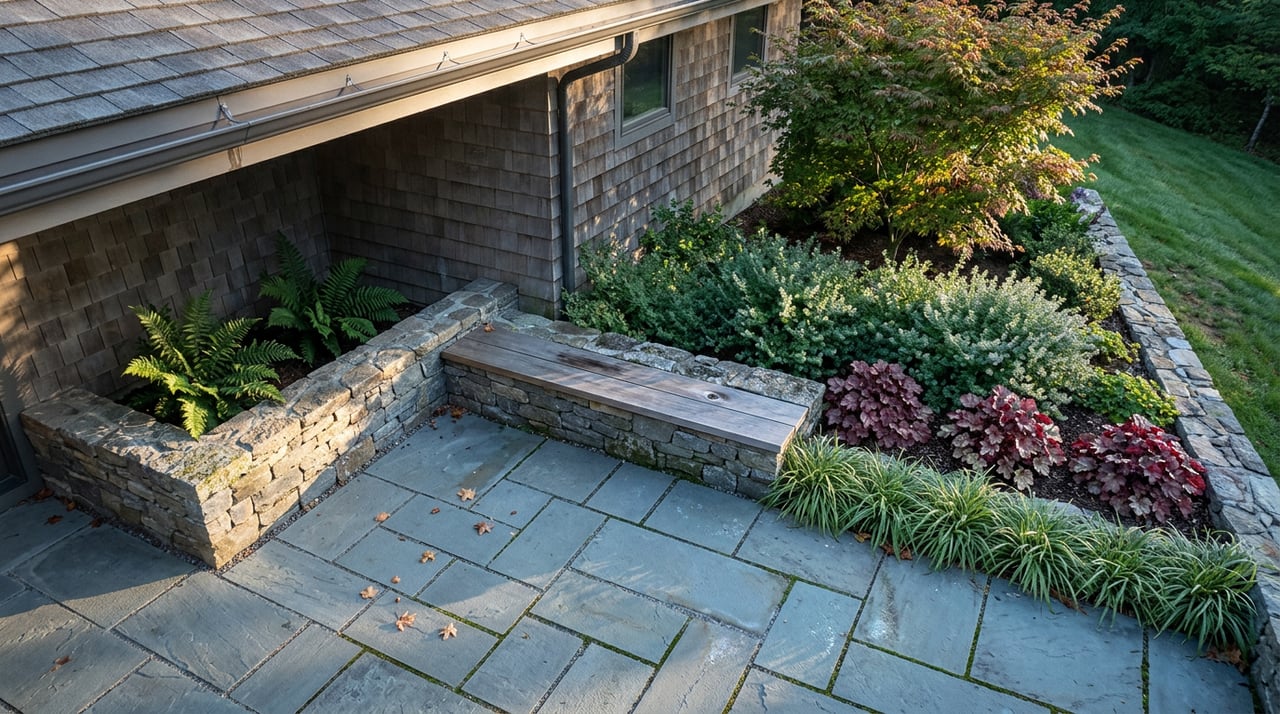
In Hamilton, Novato, the Disclosure Packet Depends on Which Street You're Buying
August 27, 2026
August 27, 2026
Drive down Hangar Avenue or Hamilton Parkway on a Saturday morning and the neighborhood reads as one continuous idea: red-tile roofs, stucco archways, perimeter walls that repeat block after block, a historic district listed on the National Register that ties it all together visually. Hamilton looks like a single, coherent neighborhood, and the marketing around it treats it that way. Ask an agent what it's like to buy here and you'll usually get one answer, one price range, one set of expectations.
That single-neighborhood framing is convenient and it is also incomplete. Hamilton was built out over roughly a decade, starting in Southgate in 1999 and mostly finished by 2006, with Hamilton Landing arriving later as its own phase. Each of those phases, among them Bayside, Southgate, Inspirations, Sunny Cove, Newport and Traditions, was recorded as its own planned development with its own declaration of covenants. The result is a neighborhood where the paperwork you sign at closing depends less on the zip code and more on which specific parcel you're standing on.
The visual continuity across Hamilton, the matching walls, the shared Spanish Revival vocabulary, comes from the fact that a single master developer built the whole thing under one reuse plan for the former Hamilton Army Airfield. But visual continuity and legal continuity are not the same thing. Bayside sits closest to the wetlands with direct access to the levee trails. Southgate is a quieter pocket set back from arterial traffic. Inspirations occupies the highest ground and carries the largest floor plans and the highest price points. Sunny Cove, Newport and Traditions fill in the middle-market range with a mix of densities.
A buyer comparing a Southgate listing to an Inspirations listing isn't just comparing square footage and elevation. They're comparing two separately governed micro-markets that happen to share a mailing address. That distinction shows up first in the disclosure packet.
When Newport and Sunny Cove were originally sold, the City of Novato required every purchaser to sign a disclosure document specifically covering former soil contamination on those parcels, along with information about existing and planned development nearby. That requirement was not applied neighborhood-wide. It was tied to those two phases because of what the land underneath them had been used for before it became residential streets.
That pattern hasn't stopped. The city's more recent Hamilton Square project, 31 townhomes proposed for a 2.7-acre site on C Street, required a remedial action plan and coordination with the Regional Water Board before construction could proceed, because the site had previously hosted a Navy gas station and the soil needed remediation before anyone could build on it. Different site, same underlying logic: a piece of Hamilton's military-industrial history sat under that ground, and buyers there inherit a paper trail because of it.
The broader base carries this same legacy at a larger scale. The Army Corps of Engineers continues to monitor cleanup at the Landfill 26 site and the North Antenna Field site, separate from its role as lead agency on the nearly 2,500-acre Hamilton Wetlands Restoration Project, for which the California State Coastal Conservancy serves as local sponsor. None of this means Hamilton is an unusually risky place to buy. It means the disclosure obligations here are parcel-specific in a way that most single-family neighborhoods in Marin simply aren't, and a buyer who assumes every Hamilton closing looks the same is skipping a document that a Newport or Sunny Cove seller is required to produce.
Every Hamilton buyer pays into the Hamilton Community Facilities District, the Mello-Roos style special tax that shows up as its own line on the property tax bill. The city created this CFD in 1995 specifically to fund the levee, roads, storm drainage, sanitary sewer and water delivery systems that make the low-lying parts of Hamilton buildable in the first place, along with ongoing park and landscaping maintenance. The bonds behind that original construction were refinanced most recently in 2014.
What makes this relevant to a buyer writing an offer this fall is the timing. The debt portion of that CFD, the piece that paid for actually building the infrastructure, is scheduled to be retired in the 2025 to 2026 cycle for many parcels. Once that happens, the special tax on those parcels drops to cover only the ongoing "Services" component: operating and maintaining the levee and its two storm-water pump stations, plus park and landscaping upkeep. That services piece continues in perpetuity. It doesn't sunset.
This is not a rounding error. It means two comparable Hamilton homes, one that closed in 2023 and one closing this year, can carry meaningfully different monthly tax obligations depending on which side of that payoff date their specific parcel falls on. A buyer's actual monthly number in Hamilton isn't just price plus mortgage. It's closer to this:
| Cost stack item | What it covers |
|---|---|
| Price and mortgage | Standard financing |
| Property tax | County base rate |
| Hamilton CFD special tax | Levee, pump station and park maintenance, with the construction-debt portion sunsetting by parcel in the 2025-2026 cycle |
| HOA dues | Varies by sub-neighborhood and product type |
| Insurance | Higher for attached product, per HOA guidance |
First-quarter 2026 sales activity in the neighborhood put single-family prices above $1.4 million, with townhome-style product trading in the $800,000s. At those price points, the difference between paying the full legacy CFD rate and the reduced post-payoff rate is real money over a 30-year hold, and it's a number worth asking your lender and title company to confirm on the specific parcel, not the neighborhood average.
The reason that Services portion of the CFD never sunsets is physical, not bureaucratic. The Hamilton Levee is a 1.4-mile earthen embankment built in 1997 by the New Hamilton Partnership, and it does real work. Some of the low-lying land it protects sits up to two feet below sea level. The levee system includes a concrete masonry splash wall, a splash wall closure gate, two storm-water pump stations and an interior drainage network, all of which require ongoing maintenance that has to be funded by someone in perpetuity.
For a buyer in Bayside or another wetlands-adjacent phase, this isn't background trivia. It's the reason your HOA and CFD documents will reference levee maintenance obligations that a buyer in, say, San Rafael's hillside neighborhoods will never see in their closing paperwork. Understanding that the levee is a funded, maintained system rather than a passive geographic feature is part of understanding what you're actually buying into.
Roughly 850 homes across Hamilton belong to the Hamilton Field of Marin Owners Association, which oversees the community's CC&Rs and Bylaws through an elected board, and each neighborhood additionally maintains its own Architectural Committee to review exterior changes like paint, solar installations and landscaping. Buyers are supposed to receive the governing documents and the association's annual operating budget before closing, not after.
Two provisions have generated real community debate over the years and are worth confirming directly with the association before you assume Hamilton works like a typical single-family neighborhood. Homeowners have described a longstanding CC&R restriction on parking in driveways that went largely unenforced for years before the board pushed to tighten it. Separately, the association has debated shifting responsibility for maintaining, repairing and eventually replacing perimeter walls away from the HOA as a whole and onto the individual owner whose lot line the wall segment sits on. Given how visible those walls are along Hangar Avenue and Hamilton Parkway, that is worth asking about directly rather than assuming either way.
None of this is unusual for a planned community. What's unusual is how much it varies within Hamilton itself, since architectural review standards and specific wall or landscaping obligations can differ by phase. The governing documents for a Traditions townhome and a Southgate single-family home are not interchangeable, even though both carry the Hamilton name.
Does every Hamilton home require the same soil disclosure? No. The requirement has historically applied to specific phases, Newport and Sunny Cove among them, tied to what that particular ground was used for before it became residential. Ask your agent or title company whether the parcel you're considering falls under one of these disclosure requirements, rather than assuming the answer is neighborhood-wide.
Will my Mello-Roos payment definitely drop? For many parcels, the construction-debt portion of the Hamilton CFD is scheduled to retire in the 2025-2026 cycle, which lowers the special tax to just the ongoing services component. Confirm the current status for your specific parcel with the title company before you finalize your monthly budget, since payoff timing can vary by phase.
Who is actually responsible for the perimeter wall next to my driveway? This has been a point of active debate within the association, with proposed governing document changes shifting that responsibility toward individual lot owners rather than the HOA as a whole. Ask for the current, adopted version of the CC&Rs for your specific sub-neighborhood before you close, since this is exactly the kind of maintenance obligation that surprises new owners.
Hamilton rewards buyers who treat it as several separately governed communities wearing one shared architectural style, not as a single line item on a spreadsheet. The historic hangars and the Marin Museum of Contemporary Art give the area its identity. The CC&Rs, the CFD schedule and the parcel-specific disclosures determine what that identity actually costs you to own.
If you're weighing a purchase or sale in Hamilton, or trying to figure out where your specific parcel falls on the CFD payoff timeline, Falla Associates can walk through the governing documents and disclosure history with you before you write an offer. Get a Free Home Valuation and we'll help you see the full cost stack, not just the listing price.
Stay up to date on the latest real estate trends.

Bay Area Living
Discover the rich history, scenic shoreline, outdoor adventures, and local favorites that make East San Rafael one of Marin's most desirable places to call home.
Partner with a team that values trust, results, and a personalized experience from start to finish.
Contact With Our Team To Learn More

FALLA ASSOCIATES
902 Irwin St San Rafael CA 94901 Jennifer Falla Firkins | CA DRE# 01255172 Alva Falla | CA DRE# 00628712