Where to Watch Novato's Winter Marshes Fill With Birds
November 19, 2026
November 19, 2026
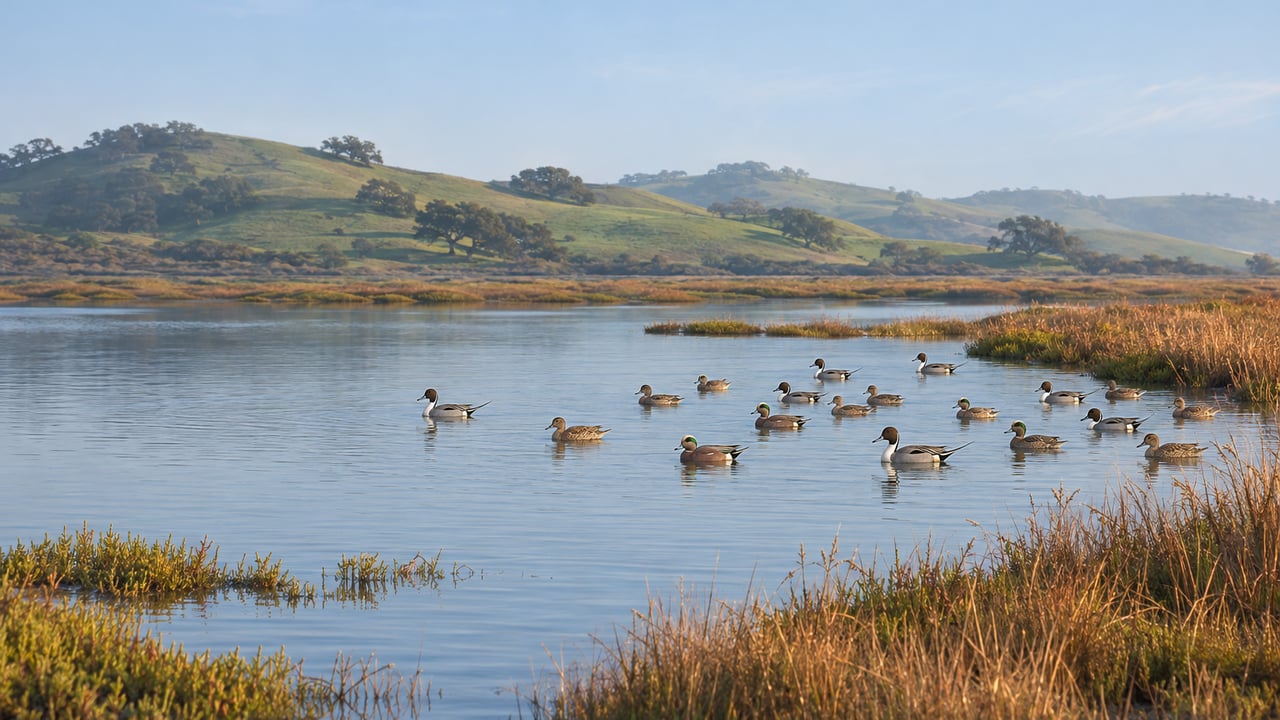
At the bottom of Bahia Drive, the tide decides what you'll see. When the bay drains out, the mudflats around the Bahia neighborhood open up and, in Marin Audubon Society's words, "thousands of shorebirds descend to feed." When the tide comes back in, the same water holds hundreds of ducks and some gulls. Those mudflats weren't always open to the tide. Marin Audubon bought the 632-acre Bahia property in January 2003. It then restored the diked baylands there to tidal action.
The same is true of most of Novato's bay edge. The marshes that fill with pintail, canvasback and sandpipers from late fall through winter are mostly land that someone bought, breached or rebuilt in the last 25 years. A countywide plan published this summer maps how much more of that work could follow. If you know which sites came back and how, it's easier to plan a winter walk there.
Marin Audubon's 2003 purchase at Bahia was split among several owners. Title to 361.7 acres of diked bayland went to the Wildlife Conservation Board, and 208 acres of oak woodland went to the Marin County Open Space District. Marin Audubon kept 61 acres. By the society's January 2006 update, the lagoon had been restored to tidal marsh.
That split is why a Bahia walk covers two kinds of country. The marsh holds the waterfowl. The oak woodland above it, which the purchase also protected, has Oak Titmice, White-breasted Nuthatch and Hutton's Vireo, plus at least four woodpecker species and many sparrows in winter. A local Wild Birds Unlimited profile of Bahia lists the winter ducks: Common and Barrow's Goldeneyes, scaup, Bufflehead, Ruddy Duck, Hooded and Red-breasted Mergansers, Canvasback, Pintail, Northern Shoveler, American Wigeon and Green-winged Teal. The same profile describes a Horseshoe Pond loop or an out-and-back walk, each under an hour, and asks visitors to stay in the signed public-access areas.
To get there, take Atherton Avenue east from Highway 101 and bear left at the Y onto Bugeia Lane, which becomes Bahia Drive. Follow it to the bottom of the hill and park along either side of the road. The trailhead is on the north side. Marin County Parks lists street parking as the only parking at the Bahia entrance.
Marin Audubon has a guided Bahia Marsh and Trail walk on Saturday, Dec. 5, from 9 a.m. to noon, which the leaders are calling their one-year anniversary field trip. Registration is required. It opens Wednesday, Nov. 25 at 8 a.m., and the walk is capped at 15 people.
Bahia is one of the two main entrances to Marin County's Rush Creek Preserve. The other is on Binford Road, where parking is usually easy to find. Pinheiro Fire Road is the broad, level route through the preserve, with views over the wetlands.
From Binford, the birds on the wetland edge can be far off. The local site Nature in Novato suggests Cemetery Marsh for closer views. It describes a 0.7-mile fire-road walk to the marsh from a small pullout on Bugeia Lane, and a longer route that starts at Bahia. Its list for Cemetery Marsh includes yellowlegs, stilts, avocets, Green-winged Teal, Northern Shovelers and Gadwall.
The same account names a long winter list for the wider Rush Creek wetlands. The shorebirds are Least and Western Sandpipers, Dunlin, dowitchers, Willet, Marbled Godwit, Whimbrel and Long-billed Curlew. The ducks are Northern Pintail, Canvasback, American Wigeon and Bufflehead. Overhead there may be Northern Harrier, Merlin, Peregrine Falcon and the occasional Bald Eagle. That account also mentions a lower waterside path on the Bahia side that floods often, so the upper trail is the more reliable choice after rain. Marin County Parks warns that the preserve's trails can be muddy in the rainy season.
Marin Audubon's ownership continues south along Atherton Avenue. The society's property list puts the Atherton Avenue Bayland, 84 acres bought in 2002, and the Fryer Trust Bayland, 60 acres donated in 2003, in its Simmons Slough Wildlife Corridor. It also owns parcels at Black Point and a 182-acre Petaluma Marsh property, where it restored 100 acres of formerly diked seasonal wetland to tidal marsh.
Simmons Slough works differently from Bahia. The roughly 140-acre property is kept as diked seasonal wetland that ponds in winter when there's enough rain. A weir with removable boards, installed by the Marin County Flood Control District, holds water on the land. No public access is planned. The views are from Atherton Avenue and from the bike path along Olive Avenue. In a wet winter, the ponds there fill with wintering waterfowl.
Deer Island is close by and makes a good pairing on the same morning. Marin County Parks describes a relatively level loop, with a small dirt lot by the Deer Island Lane entrance. The county lists White-tailed Kite, Red-shouldered Hawk, Barn Owl, Great Horned Owl, Snowy Egret, Great Egret and American White Pelican among the birds of the preserve and the marshes around it. A Marin Audubon trip description puts the walk at about 1.5 miles on dirt trail, with winter raptors possible.
On Nov. 11, 2026, a checklist from Scottsdale Pond on the eBird hotspot page recorded Northern Shoveler, Gadwall, Mallard, American Coot, Black-necked Stilt, Long-billed Dowitcher, Least Sandpiper, Ring-billed Gull, Double-crested Cormorant and Snowy Egret. Most of those species also turn up out on the marshes, so this pond near Novato Boulevard is the shortest trip on this list.
The biggest single restoration is at Hamilton. The State Coastal Conservancy says the 648-acre Hamilton site was breached to the tides in 2014. Since then it has become tidal and seasonal wetland, ecotone and upland habitat.
The San Francisco Bay Trail's map for this stretch shows about three miles of levee-top trail at Hamilton. You reach it from Hamilton Parkway via the Reservoir Hill Trail, and the southern access is from Hangar Avenue near Maybeck Street. Point Blue led a public walk on this part of the Bay Trail on Sept. 12, 2026, starting from its nursery at 737 Aberdeen Road. Avocets, Black-necked Stilts, Snowy Plovers and migratory ducks were among the birds it said walkers might see. Inland from the levee, our post on the Hamilton Amphitheater Park playground rebuild covers the park's fall projects.
Next door is the Bel Marin Keys Unit V, which adds nearly 1,600 acres to the project. Phase 1 has been built: a two-mile levee and a 45-acre seasonal wetland. The second phase, which would restore tidal action, is still in planning.
Bahia, Hamilton and Bel Marin Keys each started as a separate project. The Novato Creek Baylands Strategy, published June 30, 2026, looks at all of them together. It's a roadmap for reconnecting more than 4,000 acres of diked Novato Creek baylands to the tides, with the twin goals of reducing flood risk and restoring habitat. The San Francisco Estuary Institute, the San Francisco Estuary Partnership, the Marin County Flood Control District and Marin Audubon Society were part of the team that prepared it. Its appendices have sections on Simmons Slough, the Deer Island Basin, the Hamilton Wetlands and Bel Marin Keys Unit V.
So the sites in this guide are also the sites the plan studies. The pond you see from the Olive Avenue bike path and the levee you walk at Hamilton are both in that 2026 document.
The season's biggest organized birding day in North Marin is the Cheep Thrills Christmas Bird Count. It runs Thursday, Dec. 17, and covers North Marin and part of southern Sonoma County. Contact details for volunteers are on Marin Audubon's Christmas Bird Count page. Two other Marin counts follow: Point Reyes on Saturday, Dec. 19, and South Marin on Saturday, Dec. 26.
For a lower-key morning, park on Binford Road or at the bottom of Bahia Drive, check whether the tide is going out, and walk toward Cemetery Marsh. For more of the town around these trailheads, see our Novato neighborhood guide.
At Falla Associates, we work across Novato, from Bahia to Hamilton. If you live near Bahia, Black Point or Hamilton and want to know how being close to these open spaces factors into your home's value, we'll go over it with you. Get a Free Home Valuation.
Stay up to date on the latest real estate trends.


Partner with a team that values trust, results, and a personalized experience from start to finish.
Contact With Our Team To Learn More

FALLA ASSOCIATES
902 Irwin St San Rafael CA 94901 Jennifer Falla Firkins | CA DRE# 01255172 Alva Falla | CA DRE# 00628712